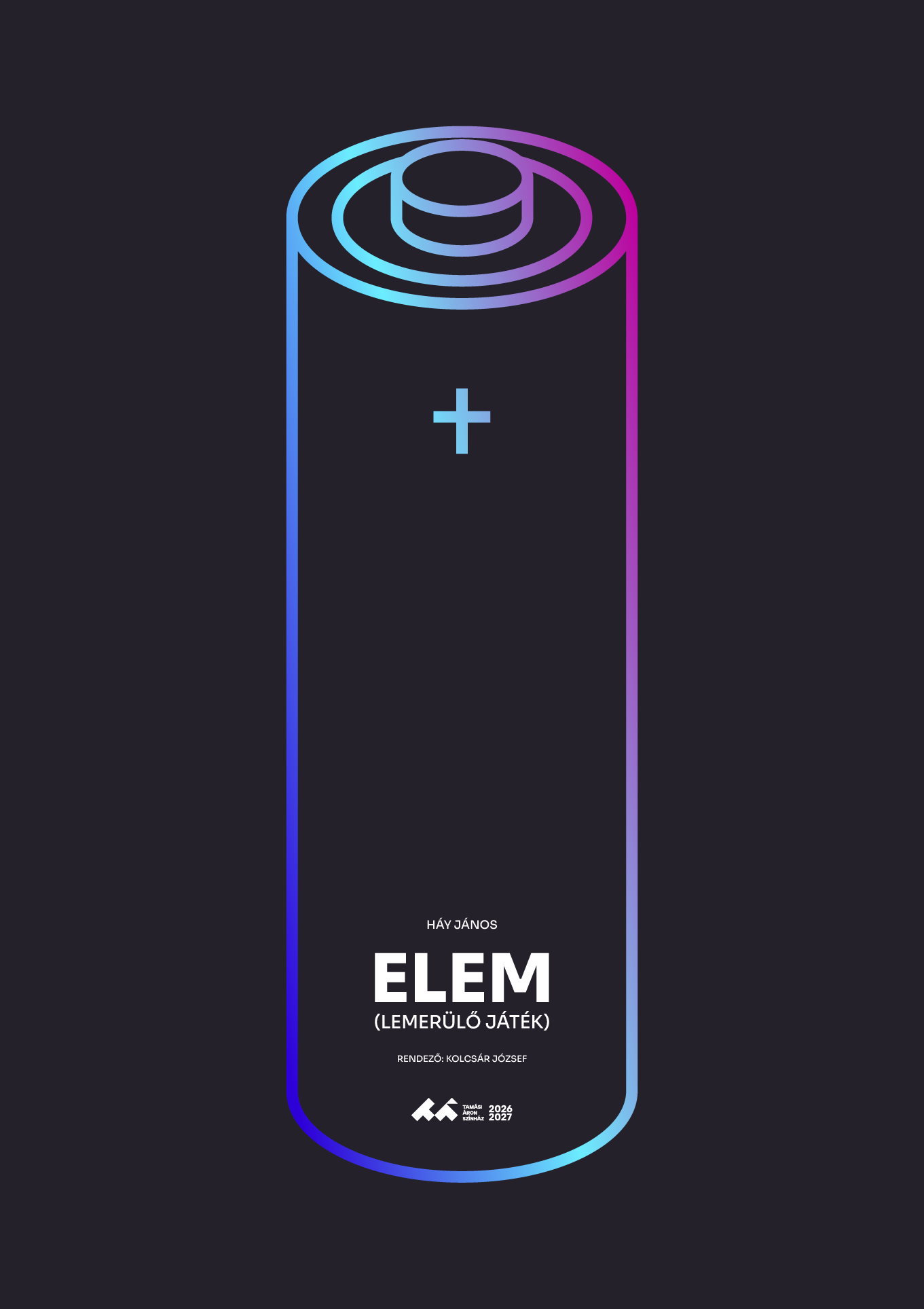
Háy János
Battery
(A game running down)
The proximity of death alters the perception of time in a peculiar way. The present slowly blends with the past, and from behind everyday conversations emerge the stories that have shaped two people’s shared life over decades.
The story of a long-standing relationship unfolds before us. Children who grow up and leave. Work that with time loses its significance. Changes in the body. Jealousy, infidelity, unspoken grievances. Minor quarrels and great acts of forgiveness. Intimacy that can feel both familiar and alien at the same time. And yet there is something that perhaps can never truly be put into words: what this life together meant to each other.
As death approaches, one involuntarily takes stock. One looks back, trying to make sense of one’s decisions, losses and relationships. Painful memories intensify, but so do the happy moments. It is as though, at the end of life, everything is placed on both sides of the scales at once.
But can a life truly be understood? We humans try time and again to unravel even that which perhaps has no solution. We seek a reason for what simply happens. Meaning in loss. An explanation for death. Something to hold onto in passing.
Meanwhile, Battery offers no easy answers. Rather, it invites us to look together at what we perhaps fear most: the passing of time, the loss of our memories, the fact that every story eventually comes to an end.
Perhaps life is not made complete by the fact that it was perfect, but by the fact that we lived it. With all its ups and downs. Because in the end, perhaps the most important question is not whether we managed to understand life, but whether there was someone with whom we shared it.